本项目内容兼顾理论与实战,旨在帮助你系统性地掌握从单个智能体到多智能体系统的设计与开发全流程。因此,尤其适合有一定编程基础的 AI 开发者、软件工程师、在校学生 以及对前沿 AI 技术抱有浓厚兴趣的 自学者。在学习本项目之前,我们希望你具备基础的 Python 编程能力,并对大语言模型有基本的概念性了解(例如,知道如何通过 API 调用一个 LLM)。项目的重点是应用与构建,因此你无需具备深厚的算法或模型训练背景。
@misc{hello_agents2025,
  title  = {Hello-Agents: Building an AI Agent from Scratch},
  author = {Sizhou Chen and Tao Sun and Shufan Jiang and Peilin Huang and Xinmin Zeng and Hao Hu and Xinzhong Zhu and all Hello-Agents contributors},
  year   = {2025},
  url    = {https://github.com/datawhalechina/Hello-Agents},
  note   = {GitHub repository}
}
From foundational theory to practical applications, master the design and implementation of agent systems
🎯 Project Introduction
If 2024 was the year of the "Battle of a Hundred Models," then 2025 has undoubtedly ushered in the "Year of Agents." The focus of technology is shifting from training larger foundation models to building smarter agent applications. However, systematic, practice-oriented tutorials are extremely scarce. For this reason, we launched the Hello-Agents project, hoping to provide the community with a comprehensive guide to building agent systems from scratch, balancing theory and practice.
Hello-Agents is a systematic agent learning tutorial from the Datawhale community. Today, agent development is mainly divided into two schools: one is software engineering-oriented agents like Dify, Coze, and n8n, which are essentially process-driven software development with LLMs serving as data processing backends; the other is AI-native agents, truly AI-driven agents. This tutorial aims to lead you to deeply understand and build the latter—truly AI Native Agents. The tutorial will guide you through the surface of frameworks, starting from the core principles of agents, delving into their core architecture, understanding their classic paradigms, and ultimately building your own multi-agent applications. We believe that the best way to learn is through hands-on practice. We hope this tutorial can be your starting point for exploring the world of agents, transforming you from a "user" of large language models to a "builder" of agent systems.
We welcome everyone to contribute their unique insights and practical summaries from learning Hello-Agents or Agent-related technologies to the community selection in the form of PRs. If the content is independent of the main text, you can also submit it to Extra-Chapter! Looking forward to your first contribution!
This Hello-Agents PDF tutorial is completely open source and free. To prevent various marketing accounts from adding watermarks and selling it to multi-agent system beginners, we have pre-added a Datawhale open source logo watermark that does not affect reading in the PDF file. Please understand~
Welcome, future builder of intelligent systems! Before embarking on this exciting journey, please allow us to give you some clear guidance.
This project balances theory and practice, aiming to help you systematically master the entire process of designing and developing from single agents to multi-agent systems. Therefore, it is especially suitable for AI developers, software engineers, students with some programming foundation, as well as self-learners with a strong interest in cutting-edge AI technology. Before learning this project, we hope you have basic Python programming skills and a basic conceptual understanding of large language models (for example, knowing how to call an LLM through an API). The focus of the project is on application and construction, so you do not need a deep background in algorithms or model training.
The project is divided into five major parts, each being a solid step towards the next stage:
Part 1: Agent and Language Model Fundamentals (Chapters 1-3), we will start from the definition, types, and development history of agents, sorting out the ins and outs of the concept of "agents." Then, we will quickly consolidate the core knowledge of large language models, laying a solid theoretical foundation for your practical journey.
Part 2: Building Your LLM Agent (Chapters 4-7), this is the starting point of your hands-on practice. You will personally implement classic paradigms such as ReAct, experience the convenience of low-code platforms like Coze, and master the application of mainstream frameworks like Langgraph. Finally, we will also guide you to build your own agent framework from scratch, giving you the ability to both "use wheels" and "build wheels."
Part 3: Advanced Knowledge Extension (Chapters 8-12), in this part, your agent will "learn" to think and collaborate. We will use the self-developed framework from Part 2 to deeply explore core technologies such as memory and retrieval, context engineering, and Agent training, and learn communication protocols between multi-agents. Finally, you will master professional methods for evaluating agent system performance.
Part 4: Comprehensive Case Studies (Chapters 13-15), this is the intersection of theory and practice. You will integrate what you have learned and personally create intelligent travel assistants, automated deep research agents, and even a cyber town that simulates social dynamics, tempering your construction ability in real and interesting projects.
Part 5: Capstone Project and Future Outlook (Chapter 16), at the end of the journey, you will face a capstone project, building a complete multi-agent application of your own, comprehensively testing your learning outcomes. We will also look forward to the future of agents with you, exploring exciting frontier directions.
Agents are a rapidly developing field that is extremely dependent on practice. To achieve the best learning effect, we provide all supporting code in the project's code folder. We strongly recommend that you combine theory with practice. Please be sure to personally run, debug, and even modify every piece of code provided in the project. You are welcome to follow Datawhale and other Agent-related communities at any time. When you encounter problems, you can ask questions in the issue area of this project at any time.
Now, are you ready to enter the wonderful world of agents? Let's start right away!
🤝 How to Contribute
We are an open-source community and welcome any form of contribution!
🐛 Report Bugs - Found content or code issues, please submit an Issue
💡 Make Suggestions - Have good ideas for the project, welcome to initiate discussions
📝 Improve Content - Help improve the tutorial, submit your Pull Request
✍️ Share Practice - Share your learning notes and projects in "Community Contributions"
Thanks to @Sm1les for help and support for this project
Thanks to all developers who have contributed to this project ❤️
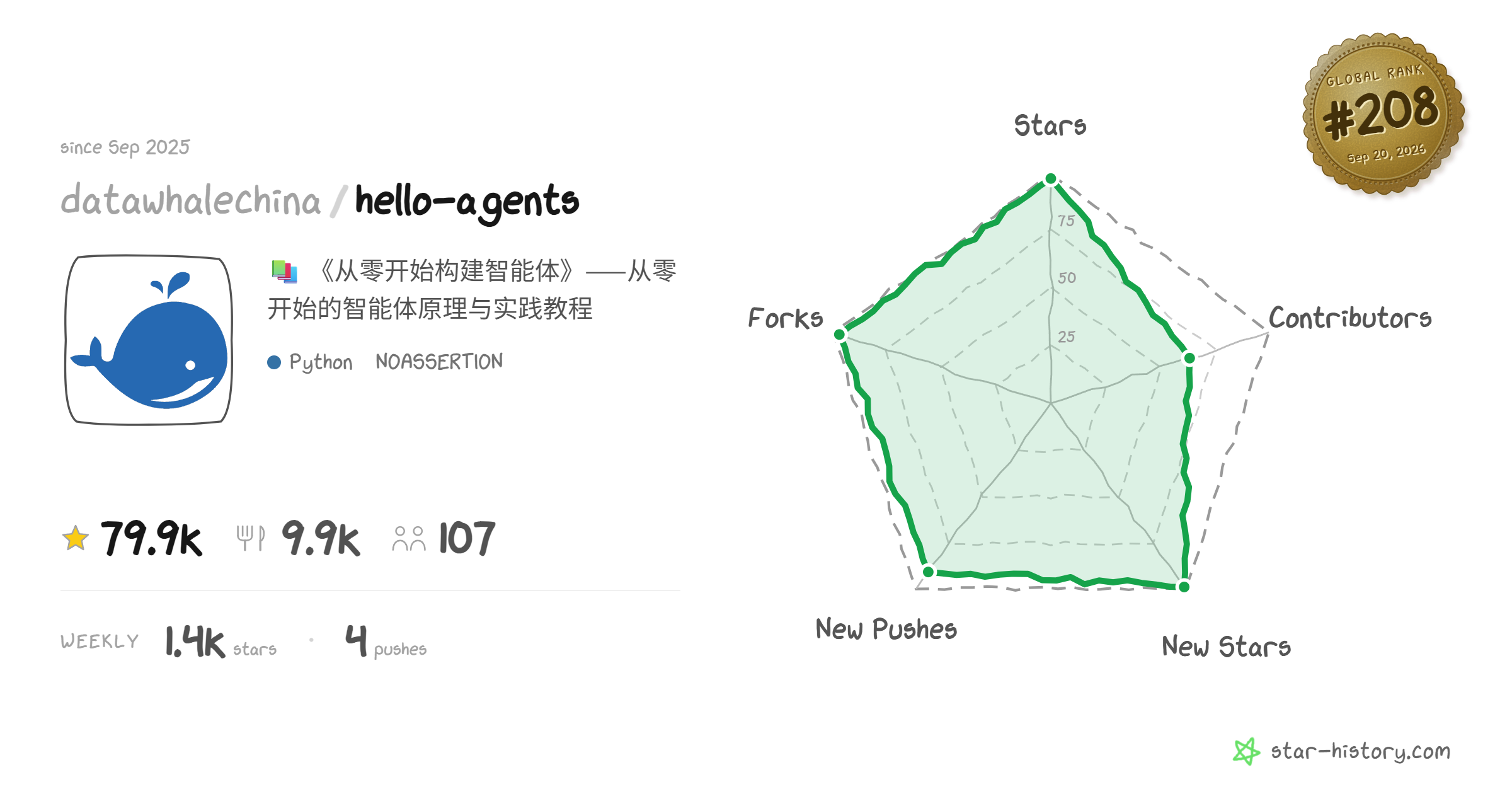
Star History
⭐ If this project helps you, please give us a Star!
Reader Community Group
Scan the QR code to join the reader community group and discuss with more learners
About Datawhale
Scan the QR code to follow the Datawhale official account and get more high-quality open source content
🎓 Citation
If Hello-Agents is helpful to your research or work, please cite:
@misc{hello_agents2025,
  title  = {Hello-Agents: Building an AI Agent from Scratch},
  author = {Sizhou Chen and Tao Sun and Shufan Jiang and Peilin Huang and Xinmin Zeng and Hao Hu and Xinzhong Zhu and all Hello-Agents contributors},
  year   = {2025},
  url    = {https://github.com/datawhalechina/Hello-Agents},
  note   = {GitHub repository}
}